
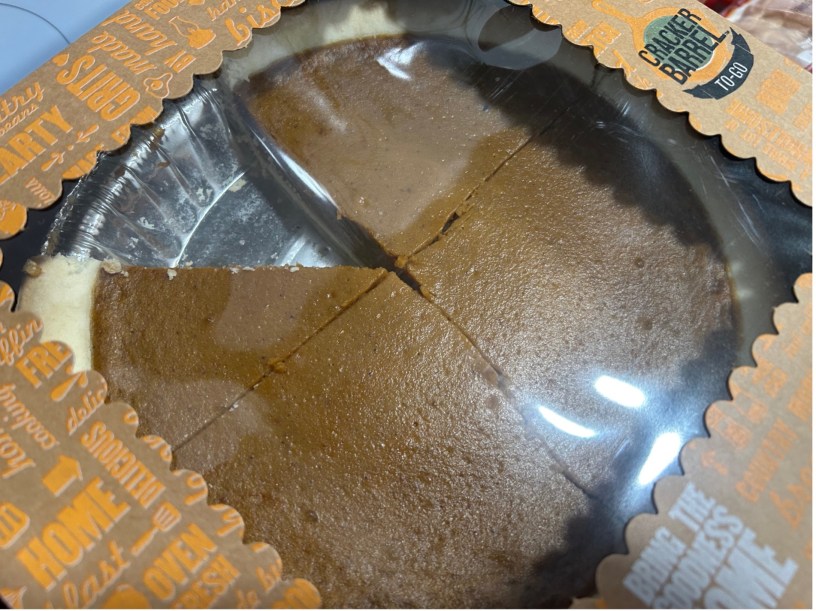
On the morning before Thanksgiving 2025, I wake up to this. A picture that may appear highly unremarkable to you right now or me at other seasons of life…when nothing could be further from the truth. It captures a choice by my youngest son last night to savor the moment despite all that is tough and unresolved in his chronic pain-riddled body/soul. For context, we are currently spending the week of Thanksgiving in Denver, a very different setting than “normal” for medical consultations that will likely lead to some pretty delicate surgery for His going-on-five years of facial and spinal pain with all it accompanying emotional, mental, and spiritual battles. We, as a family of three (Ian is celebrating Thanksgiving in Alabama with college friends), picked up this pie amongst other hearty menu items because we choose to have gratitude towards a God that we believe is worth waiting upon. What a thrill to see our son-with all that kept him up late last night-tangibly fighting for the same sanctifying heart position!
As we move around amidst the hum of this large Colorado city filled with the usual holiday preparations including long restaurants lines, clogged grocery aisles, and evergreen trees clinging to the top of vehicles, I am struck by how many in our world-like the Snode family-enter into yet another Thanksgiving/Christmas/New Year’s while living under a very difficult and disorienting fog that threatens to never lift. Probably this Thanksgiving finds you with a lot of unresolved issues/not fully-delivered-on-yet promises that could cause all of us to feel like we can rightfully opt out of gratitude. What are we do with that tension in our very souls of striving to be grateful with all that is not perfect in our checking accounts, bodies, relationships, etc.? Psalm 118 reminds us that we can and must express gratitude to the God “whose mercy endures forever” (vv. 1, 29) no matter where this Thanksgiving finds us by embracing two divine processes.
Be grateful for what is “becoming.”
Ps 118:19-24 “Open to me the gates of righteousness: I will go into them, and I will praise the LORD: This gate of the LORD, into which the righteous shall enter. I will praise thee: for thou hast heard me, and art become my salvation. The stone which the builders refused is become the head stone of the corner. This is the LORD’S doing; it is marvellous in our eyes. This is the day which the LORD hath made; we will rejoice and be glad in it.”
If we are to live by faith that alone fuels and funds gratitude in our presently broken/fallen world, then our focus must always been leaning forward towards the FUTURE!
The second half of this Psalm begins by stating that this “becoming” is not for just a select few who have it all together; it available to all (19-21)! In verse 19, Redeemed Israel seeks admission to the temple courts in order to offer sacrifices of thanksgiving to the Lord. Verse 20 includes the words of those Levites who are doorkeepers at the temple. They explain that this gate belongs to Jehovah and is for the use of those godly ones who wish to draw near to Him. God—the One overseeing everything still in process—is to be praised because He hears our prayers and has become our salvation in verse 21…more than enough reason to be grateful.
Chad Bird posted the below picture with the following caption: “When visiting the temple in Jerusalem during the time of Jesus, this is one of the warning signs you would have seen. These appeared both in Latin and Greek. They were outside the inner court of the temple. It reads, ‘No stranger is to enter within the balustrade round the temple and enclosure. Whoever is caught will be himself responsible for his ensuing death.’ There can be no more striking contrast between this and what has been given to us in the Messiah, our great High Priest.”

Because God is willing, we can be righteous and enter an AVAILABLE-TO-ALL GOD’S gates WITH THANKSGIVING…no matter what else is still IMPERFECT/INCOMPLETE! Where are you choosing to unnecessarily head in the exact opposite direction?
Secondly this countercultural Psalm boldly declares that this “becoming” is irresistible (22-24). Verse 22, describing the chief cornerstone, was probably a proverb of that day referring to Israel being rejected by the great empire-builders of the day as unworthy to fit into their plans. But the divine mission of Israel became focused and fulfilled in its greatest representative, the Messiah. Jesus quoted verses 22–23 in His debate with the religious leaders (Matt. 21:33–46); not even organized religion can stop what God is the process of doing! The reason that the “process” should be “marvelous in eyes” is that is not the work of men but good, faithful, glorious God who—in the end-will not let us down! (Any immediately-gratifying shortcut of man will ultimately do just that…let us down.) This day made by the Lord likely refers to the most remarkable day in history, the day in which Jesus Christ rose from the grave. That day began a whole new era of rejoicing by those who believe…while we still wait for His soon return.
God is wearing down all resistance to His redemptive plan…one day at a time…including the days that we struggle to find anything for which to be grateful! Wiersbe admonishes us, “Claim verse 24 for everyday that you live.” Where do you view every passing day “as losing ground” where you need to trust that it is as a crucial part of THE PROCESS leading us toward the DAY THAT WILL NEVER END FILLED WITH NOT ONLY FULFILLED PROMISES but new, fresh processes? According to Nancy DeMoss Wolgemuth, “Gratitude is a lifestyle. A hard-fought, grace-infused, biblical lifestyle.”
Be grateful for Who is “coming.”
Ps 118:25-29 “Save now, I beseech thee, O LORD: O LORD, I beseech thee, send now prosperity. Blessed be he that cometh in the name of the LORD: we have blessed you out of the house of the LORD. God is the LORD, which hath shewed us light: bind the sacrifice with cords, even unto the horns of the altar. Thou art my God, and I will praise thee: thou art my God, I will exalt thee. O give thanks unto the LORD; for he is good: for his mercy endureth for ever.”
What we are grateful for—while still in process—is sustained by anticipation of a future delivered by God Himself that is more real than the room we are today in Colorado or wherever.
This coming by Jesus-both the first and second times-is defined first by blessing (25-26). Those who understand David as the author of the psalm see here in verse 25 the king’s petition for the Lord’s blessing upon his reign. Those who understand the psalm to have been written during the days of Ezra and Nehemiah regard it as a prayer for the return of prosperity to Jerusalem. “He that cometh” (26) was one of the usual titles for the Messiah among the Jews. “We have blessed you out of the house of the Lord” appears to be a benediction used by the priests of the Temple as they stewarded a sacrificial system that pointed toward the day when the Messiah would come in the name of the Lord. Pfeiffer points out, “The priestly benediction of verse 26 found expression six times in the Gospels because of its distinct application to the mission of Christ.” This is clearly a messianic psalm as the crowds also shouted verses 25–26 as Jesus rode into Jerusalem on Palm Sunday (Matt. 21:9). A moment in Jerusalem, by the way, the occurs between 500 and 1000 years after this promise is claimed in Psalm 118 (took some time to say the least)!
“Who’s COMING?” is a key question that defines how the Thanksgiving meal will go/not go! We have God Himself on the march towards us throughout time. God does not stay a cool, aloof distance; He comes!!! The incarnation declares that He comes and gets involves Himself in all of our mess…where are you living without that reality gripping and pacing your heart?!
Lastly this coming of Jesus is a sustained coming (27-29). In the messianic context, the beginning of verse 27 must mean that Jehovah has showed unto us the Messiah, the Light of the World (Co. 1:13). The word “cords” has the idea of “thick branches.” The second half of Psalm 118:27 likely refers to the custom at the Feast of Tabernacles of waving branches before the Lord. The resolve in verse 28 comes as a direct result of the psalmist’s recollection that Jehovah has heard his prayer and has become his salvation. The psalm concludes in verse 29 as it began in verse 1, making a complete circle of joyous praise to God who is good and offers mercy that endures forever. “He is good” refers to His abiding character not our immediate circumstances…otherwise we cannot “in everything give thanks!”
No matter the immediate “setback,” God’s schedule is right on track and will be fully realized in the second coming of Jesus…how do we know that? He precisely fulfilled His promises on the FIRST COMING! What artificial sources of “sustaining power” do you need to abandon?
In summary the Jewish people sing Psalms 113 to 118 at Passover, so this is one of the songs that Jesus sang before He went to the Garden to pray (Matt. 26:30). If you knew you were going to be executed unjustly, would you be able to sing praises to the Lord? Jesus models for us what divine grace can enable us to do and be while “going through it”-grateful.
Heidi is renown in our home for getting endearingly confused with her phone usage….her and I would be described as “pre-digital natives.” Nowhere was this more on display than in a recent New Jersey conversation as a part of our #healthforlandon journey while putting dates on her calendar app in 2086 until I questioned her about it and the comforting conversation that followed.
Heidi: Will we be in heaven by then?
Me: Uh, yes.
Heidi: Good!! (Only true for two fatigued-in-the-grind parents who will be “dead” from this world’s perspective because God is good!)
No matter how young or old, do you think that the year 2086 will find much if not all that you wish would be resolved right now addressed by the goodness and mercy of our God? The answer, by faith and with gratitude, is a definitive yes! Therefore, will you join all the wracked-by-pain-sorrow-and-struggle Psalmists and Landon’s of the world who choose to belly up to God’s chosen “piece” of divine process by being more grateful for WHAT IS BECOMING and WHO IS COMING?
 HARLEY SNODE